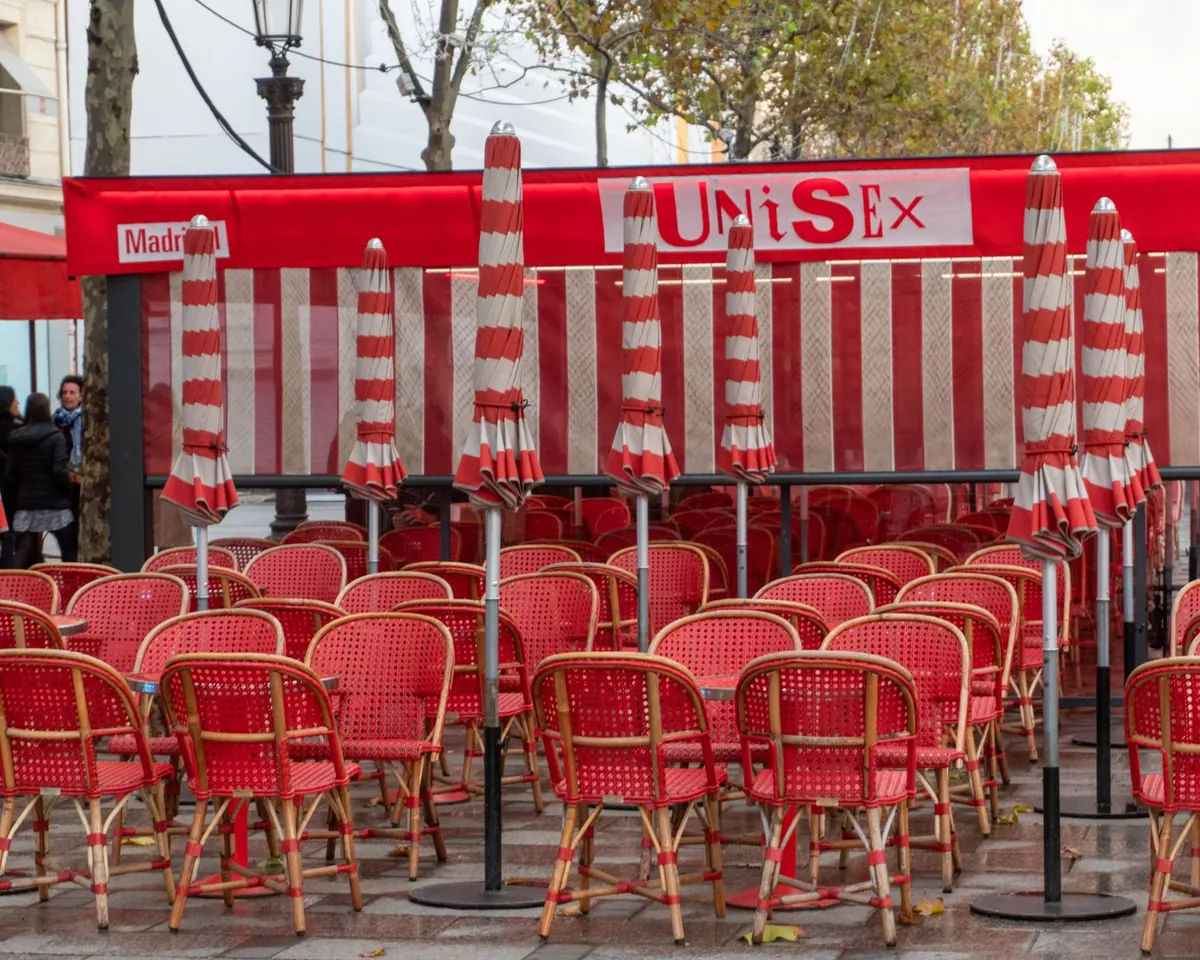
Shade is the difference between a table people linger at and one they abandon at the first hint of midday glare. But the three obvious answers — an awning, a parasol, a pergola — behave very differently once the sun moves, the wind picks up and the plates come out. Each one solves a slightly different problem, and the one that suits your terrace depends far less on taste than on walls, wind and the hour you usually sit down to eat.
Start With the Table, Not the Canopy
Before you compare anything, spend a week watching the space. Note when you actually eat there and where the sun sits at those hours. A west-facing terrace in July can be pleasant at one in the afternoon and punishing at seven, when the sun drops low and slides in underneath any overhead cover. That situation calls for something with a low, adjustable edge — a tilted parasol, a drop blind at the side of an awning — not a flat canopy three metres up.
Then look at what you already have. Is there a solid wall or a beam to fix to? Is the terrace enclosed by buildings that funnel wind, or open to a field where it arrives unchecked? Do you rent, or own? A pergola that needs post foundations is a different proposition in a rented flat than in a house you plan to keep.
Be honest about maintenance, too. Fabric needs brushing and occasional cleaning, timber needs oiling, aluminium needs very little. Whatever you choose will be asked to sit outside for years.
Awnings: Shade Attached to the Building
A retractable awning is the neatest way to borrow shade from the house. It fixes to a wall or a sturdy beam, rolls out over the terrace and disappears into a cassette when not in use, which keeps the facade clean and the fabric out of the weather.
Coverage is generous relative to the space taken up, because the arms project from the wall rather than standing on the terrace. That means no base to trip over, no pole through the middle of the table, and the whole floor stays usable. The trade-off is that the shade is tied to the building: it covers the strip nearest the wall best and fades as it reaches the outer edge, and the further it projects, the more the front bar tends to sag unless it is properly tensioned.
Practical points worth checking before you buy: the drop of the front bar must clear doors and tall guests — aim for roughly 2.1 to 2.2 metres of clearance at the lowest point you will actually use; the wall or beam must be sound enough to carry the load; and manual cranks are fine for occasional use while a motor earns its keep on an awning you open every day.
Wind is the weak spot. An extended awning is a sail, and gusty weather is when they tear. Retract it whenever you leave the house and whenever the forecast turns. Most retractable awnings are built for sun, not for heavy rain, so check whether yours is rated for water and, if not, roll it in before a storm.
Parasols and Umbrellas: Shade That Moves
A parasol is the most flexible of the three and usually the cheapest way to get started. A centre-pole model through the table hole is compact and simple; a cantilever or side-pole model keeps the space under the canopy completely clear, which matters if you like to push two tables together or move the whole arrangement for a party.
That flexibility is the point. You can tilt the canopy as the sun moves, rotate a cantilever model to follow it, and take the whole thing down at the end of the season. It also means you can buy one good parasol now, live with it for a summer and only then decide whether a permanent structure is worth the outlay.
The catch is the base. A parasol is a lever, and the larger the canopy, the more weight it needs at the bottom. Water or sand-filled bases are the usual answer, and a heavy one is not optional — a light plate under a big canopy is how parasols end up on their side against a fence. Wind is the other limit: close the parasol whenever it is not in use, and choose a model with a vent at the crown so gusts pass through instead of lifting it.
Coverage is narrower than an awning. As a rough guide, the canopy should overhang the table by at least half a metre on every side, so measure the table before choosing a diameter rather than after.
Pergolas: Built for Staying Put
A pergola is a room without walls. Four posts, a frame and either fixed slats, adjustable louvres or a retractable fabric roof underneath. It defines the dining area in a way the other two cannot: it gives height, a place to hang lights or grow a climbing plant, and a sense that the table has a home rather than a spot.
It is also the largest outlay of the three, partly because installation is not optional. Posts need anchoring into the ground or ballasting heavily, and a structure that size catches a lot of wind. Timber is warm and repairable but needs periodic treatment; powder-coated aluminium costs more upfront and asks almost nothing of you afterwards. Adjustable louvres give the finest control — you can angle them for low evening sun or open them to let heat out — and they cost accordingly.
Fixed slats give dappled shade rather than full cover, which is often pleasanter at midday than a solid roof but does little in slanting rain. If you want the area usable in poor weather, plan for a fabric or solid roof from the start rather than adding it later.
One practical note: structures of this size can fall under local planning or building rules, and the answer varies by location and by whether the pergola is attached to the house. Check with your local authority before ordering, particularly if you are in a listed building or a conservation area.
Compared: Cost, Flexibility, Wind and Feel
- Cost. A parasol is the lowest entry point and can be upgraded later. An awning sits in the middle, with motorisation and a larger projection pushing it up. A pergola is the biggest commitment, and installation is a real part of the budget rather than an afterthought.
- Flexibility. The parasol wins: it tilts, rotates, moves and stores. An awning offers adjustable projection and pitch but stays on its wall. A pergola is the least adaptable — you decide its position once.
- Wind resistance. A well-anchored pergola frame is the most secure, though its roof fabric or louvres still need attention in a gale. A parasol with a properly weighted base is next, provided you close it. An extended awning is the most vulnerable and should be retracted whenever wind is forecast.
- Effect on the dining area. An awning makes the terrace feel like an extension of the house, shaded and slightly enclosed. A parasol keeps the table at the centre of an open space, airy and easy to rearrange. A pergola gives structure — a defined room that reads well from the garden and works after dark with a few warm lights on the beams.
Four Details That Decide It
- Headroom. Measure the clearance at the lowest point of whatever you choose, and check it against your tallest guest and your door swing.
- Anchoring. Decide honestly how the thing will be held down. Wall fixings, ground anchors, ballast — one of them has to be right.
- Airflow. Leave a gap between the canopy and the table. A sealed layer of hot air directly above the plates is worse than a little dappled sun.
- Evening use. Shade and light are the same problem seen twice. Plan where a cable or a bracket will go before the structure is up.
A Practical Way to Choose
If you rent, if there is no sound wall to fix to, or if you want to be able to rearrange the terrace on a whim, buy a good parasol with a base heavy enough to trust and spend the difference on a table you love. If the terrace sits against the house and you eat out there most days from spring to autumn, an awning will give you the most usable floor for the money. If you have decided to stay, want the outdoor room to feel designed, and can absorb the installation, a pergola is the one you will still be glad about in ten years.
And there is no rule against combining them. An awning over the door and a parasol at the far end of a long terrace often covers more of the day than either would alone — which, in the end, is what shade is for.
Photo: Louis / Pexels